
D3 · Discover. Debate. Decide.
AI should challenge the answer before you trust it.
Most AI systems are designed to give you an answer. Because when the decision matters, one confident answer is not enough.
Three stages. One defensible decision.
From competing evidence to a recorded decision.
Discover.
Agents independently gather and evaluate evidence so every position begins with something that can be checked.
Debate.
Agents state their positions and confidence while D3 tracks agreement, disagreement, argument strength, and how opinions change.
Decide.
D3 presents the evidence, consensus, dissent, and recommendation. An authorized person makes the final decision to approve, reject, or defer.
Consensus should be measured, not assumed
Agreement is not the same as being right.
Multiple intelligent agents agreeing does not automatically mean the answer is right. D3 evaluates consensus using agreement, confidence, argument quality, and supporting evidence.
It also looks for groupthink. If several agents rely on the same underlying model or source, their agreement can be discounted so an AI echo is not mistaken for independent confirmation.
Nine agents are not necessarily nine independent opinions.
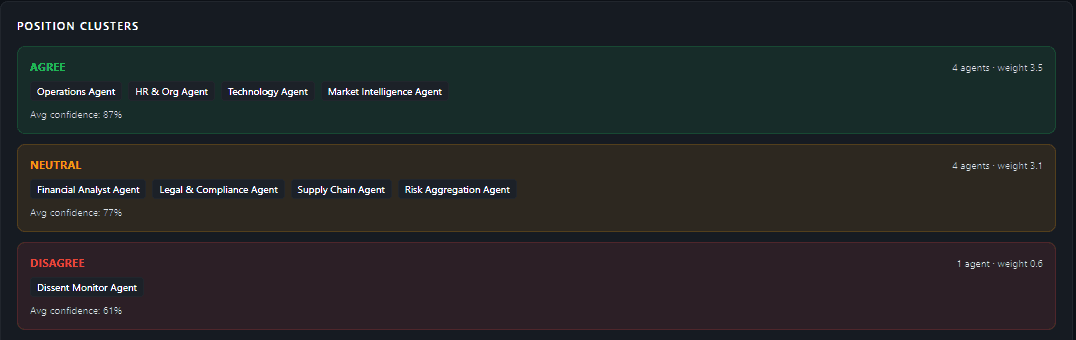
Shared-source agreement is discounted.
Groupthink diagram illustrates the concept
The ability to see what the majority may be missing.
Dissent is never buried
Disagreement stays on the record.
One of D3's most important capabilities is preserving disagreement. When an agent challenges the leading position, its reasoning remains visible as a Minority Report along with the strength of its argument.
That gives leadership something traditional AI often does not.
Human authority
The system recommends. A person decides.
D3 is built around human authority. No high-impact action moves forward without authorized review. The final decision, decision maker, timing, and rationale can become part of the permanent record.
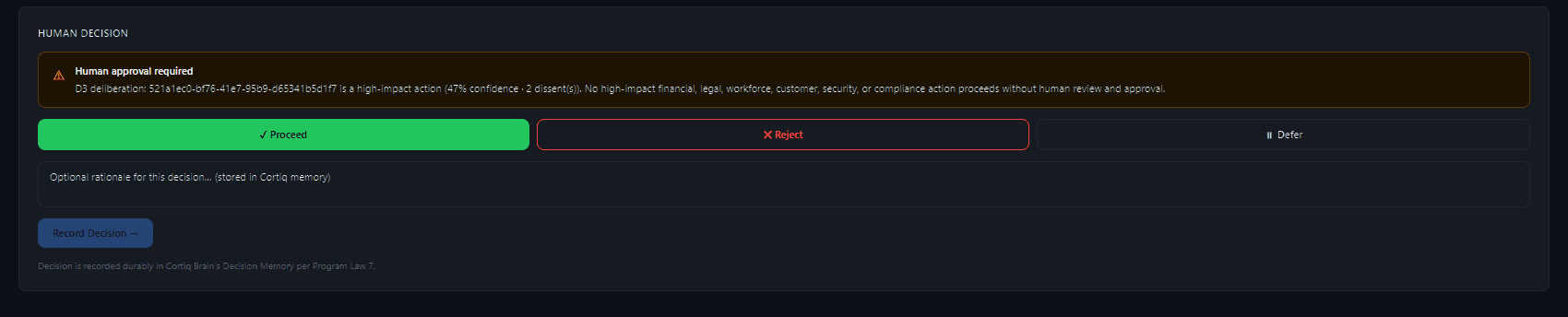
Evidence before confidence. Debate before decision. Human authority before action.
A better way to make high-stakes decisions
Not another AI-generated opinion.
D3 gives leadership a structured way to evaluate questions involving uncertainty, competing evidence, risk, or material consequences.
01
What the evidence supports
02
Where the agents disagree
03
How strong the consensus really is
04
What risks remain unresolved
05
Why the recommendation was made
06
What evidence supports the conclusion
The result is not simply an answer. It is a decision leadership can understand, challenge, and defend.